Builder Gel for Professionals: How to Judge One
22 Aug 2026 · VIRAA Professional · 3 min read
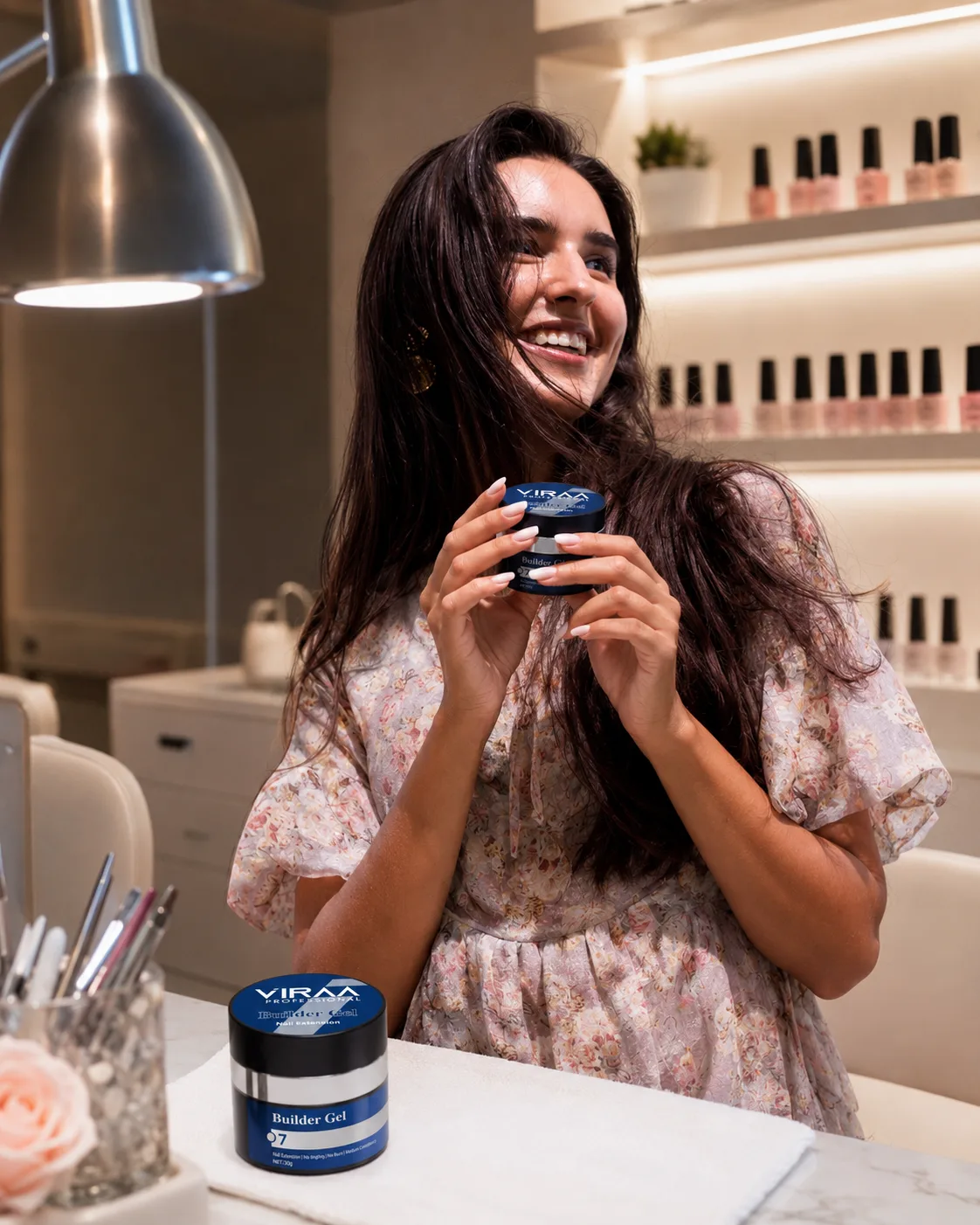
Every builder gel on the market calls itself professional. The word means nothing on a label, but the difference between a professional gel and a retail one is real and it is testable in three places.
1. Viscosity — how it behaves while you work
Builder gel has one hard job: hold a shape long enough for you to place it, then level just enough to leave a surface you do not have to rescue with a file.
- Too thick and it holds an apex beautifully but will not self-level. You file back what you should have placed, which costs time and thins the overlay.
- Too thin and it levels itself into the cuticle while you are still working on the next finger. That flood is the single most common cause of lifting.
- Medium is the working answer for most technicians and most nails. If you own one builder gel, own a medium.
Our Builder Gel is a medium consistency for that reason. The glitter range runs slightly thicker, as suspended glitter always does.
2. Cure depth — the failure nobody sees
This is the one that catches people out, because it looks fine.
Gel cures from the light down. A layer applied too thick, or cured under an underpowered lamp, sets hard on the surface while the material against the nail stays soft. The client leaves happy. Ten days later the whole overlay lifts off in one piece and everyone blames the prep.
How to check it. Cure a test blob on a tip at your normal thickness, then press a fingernail into the underside. If it dents, your layer is too thick for your lamp — not necessarily a bad gel and not necessarily a bad lamp, but the two together are not curing what you are applying. Thinner layers or a stronger lamp both fix it.
3. What is actually in it
This is where the professional distinction stops being about performance.
HEMA is a small, mobile monomer used widely in gel systems. It is also a well-documented cause of allergic contact dermatitis, and in the published literature nail technicians make up the majority of reported occupational cases. A market survey of nail cosmetics found it in a large share of products sold as professional.
TPO is a photoinitiator — the thing that makes gel cure under a lamp. The EU banned it in cosmetic products from 1 September 2025 after it was classified as toxic to reproduction.
The asymmetry is the point. Your client is exposed for an hour a month. You are exposed for eight hours a day, every working day, for as long as you do this. Every VIRAA gel is TPO and HEMA free — what that actually means goes into the detail.
Builder gel, BIAB and polygel
| Product | Best at | Applied with |
|---|---|---|
| Builder gel | Overlays, strengthening, short extensions | Brush, from a jar |
| BIAB | Natural-nail overlays, fastest to apply | Bottle brush |
| Polygel | Length and sculpted extensions | Spatula and brush, with slip |
Most working salons carry all three and reach for whichever suits the nail. If you are starting, builder gel vs polygel is the decision to make first, and the polygel kit list covers what an extension set takes.
A short checklist before you buy
- Is it medium viscosity, or does the listing avoid the question?
- Does it cure at the thickness you actually apply, under the lamp you actually own?
- Is it TPO and HEMA free, stated plainly rather than implied?
- Can you buy it again in six months? A gel you cannot restock is a gel you cannot build a service on.