Nail Dust Collector in India: Why Your Table Needs One
19 Aug 2026 · VIRAA Professional · 4 min read

Nail dust is not sawdust. Filing a gel or acrylic overlay produces particles fine enough to stay airborne long after you have finished the nail, and they carry whatever was in the product before you filed it — uncured monomer included.
You breathe it. So does the client sitting eighteen inches away. It settles on the shelf behind you, on your tools, and on the next client's cuticle oil.
A dust collector is the least glamorous thing on the table and the one that changes your working day most.
What extraction actually does
Three things, in the order you will notice them:
- It keeps the dust out of the air you are breathing. NIOSH guidance on artificial nail application puts local exhaust ventilation ahead of masks in the order of controls, because removing dust at the source beats filtering it after it has reached your face.
- It keeps the table clean. Less wiping between clients, and a nail that is not resting in a film of its own filings when you go to apply top coat.
- It changes how the salon looks. A visible dust cloud reads as an unhygienic room whatever the truth is. Clients notice.
The health case, stated carefully. Occupational exposure to nail dust and vapours is a recognised hazard, and OSHA's guidance for nail salons and HSE's work on respiratory sensitisers both treat ventilation as a primary control. What nobody can tell you is your personal risk from your specific working pattern. The sensible reading is that extraction is cheap relative to a career, not that a technician without one is in danger today.
How to judge a unit
Where the intake sits
This is the whole game and it is the thing spec sheets never mention. Dust travels a few centimetres before air resistance takes over. If the intake is under the client's hand, it catches the filings. If it is off to the side, it catches the room.
A unit whose top surface is the hand rest solves this by design — the hand goes where the suction is, every time, without you thinking about it.
Filter, not just fan
A collector without a real filter is a fan that redistributes the problem. Look for a filter you can actually remove and inspect. If you cannot see it, you cannot tell when it is loaded, and a loaded filter quietly stops working while the motor still sounds busy.
Noise
You will run this for hours. A unit you find irritating in the shop will be intolerable by week three, and the one that gets switched off is worth nothing. Run it before you buy if you possibly can.
Table-top, built-in, or combination
| Type | Suits | Trade-off |
|---|---|---|
| Table-top | Most salons, mobile artists, anyone renting a chair | Takes desk space; moves with you |
| Built-in | A fitted salon with fixed stations | Quieter and tidier; commits you to that desk |
| Combination | A new station being kitted out from nothing | One base, one plug — but if it fails you lose all of it |
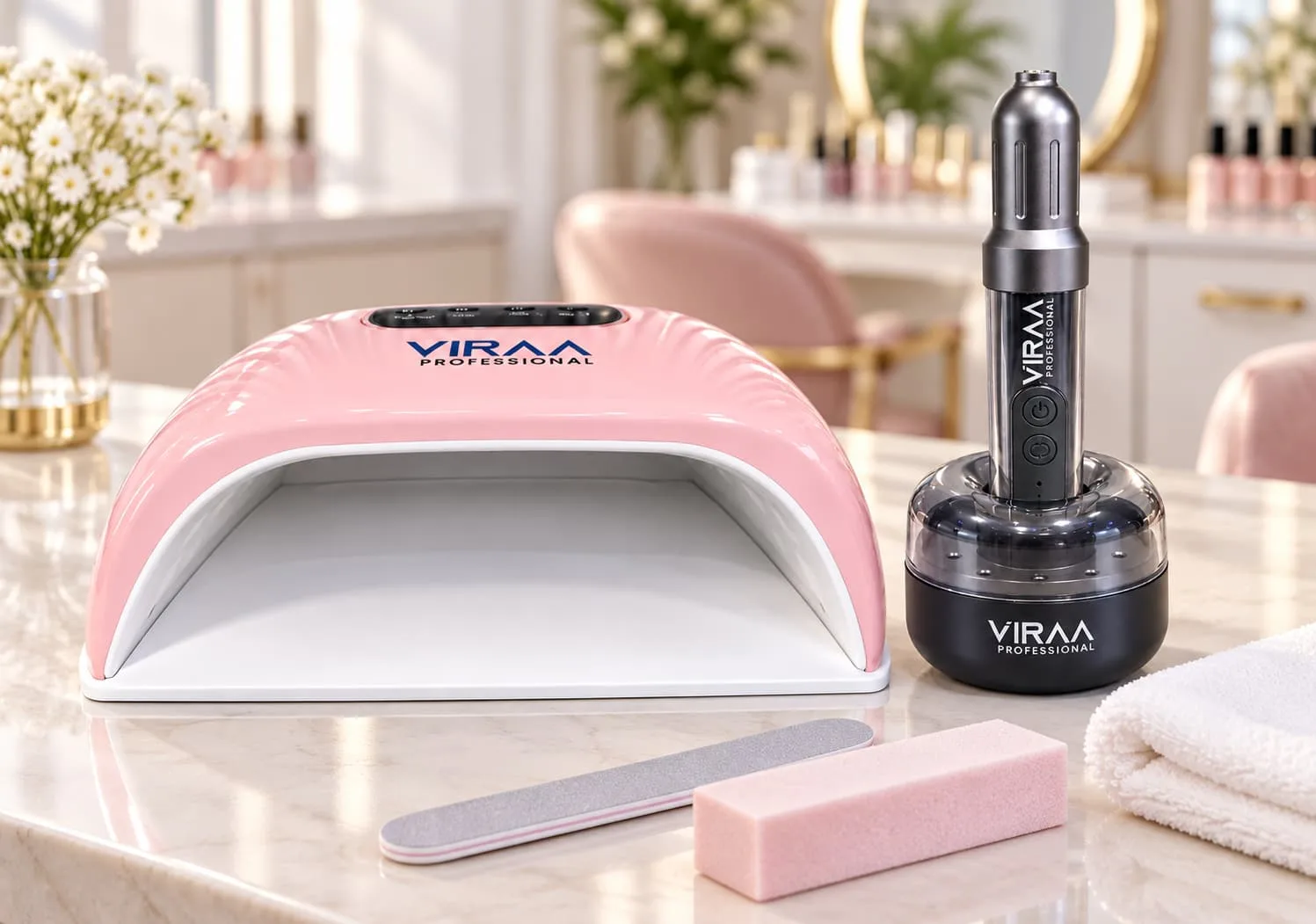
Our 2-in-1 Dust Collector & Lamp is the straightforward version: extraction plus curing in one footprint. The 4-in-1 Dust Collector, Drill, Lamp & Hand Rest adds the drill and the rest, which is what most technicians end up buying separately anyway.
What it costs
Standalone extraction in India starts around Rs. 5,000. A combination base runs to around Rs. 13,000. Set against a single station that turns over that in a week of gel sets, it is not the expensive decision on the table — the equipment list has the rest of them in the order we would buy them.
Getting the most out of it
- Switch it on before you start filing, not once you can see dust.
- Work over the intake. If your hand drifts, the extraction does not follow.
- Check the filter when suction changes, and keep a spare rather than running a loaded one.
- Do not use it as a substitute for airflow in a small room. It is a local control, not ventilation.
If you are also choosing the drill it sits next to, what to look for in a professional nail drill covers RPM, torque and the bits that matter.