Soft Gel Tips vs Sculpted Extensions: Which Should You Offer?
17 Sep 2026 · VIRAA Professional · 9 min read
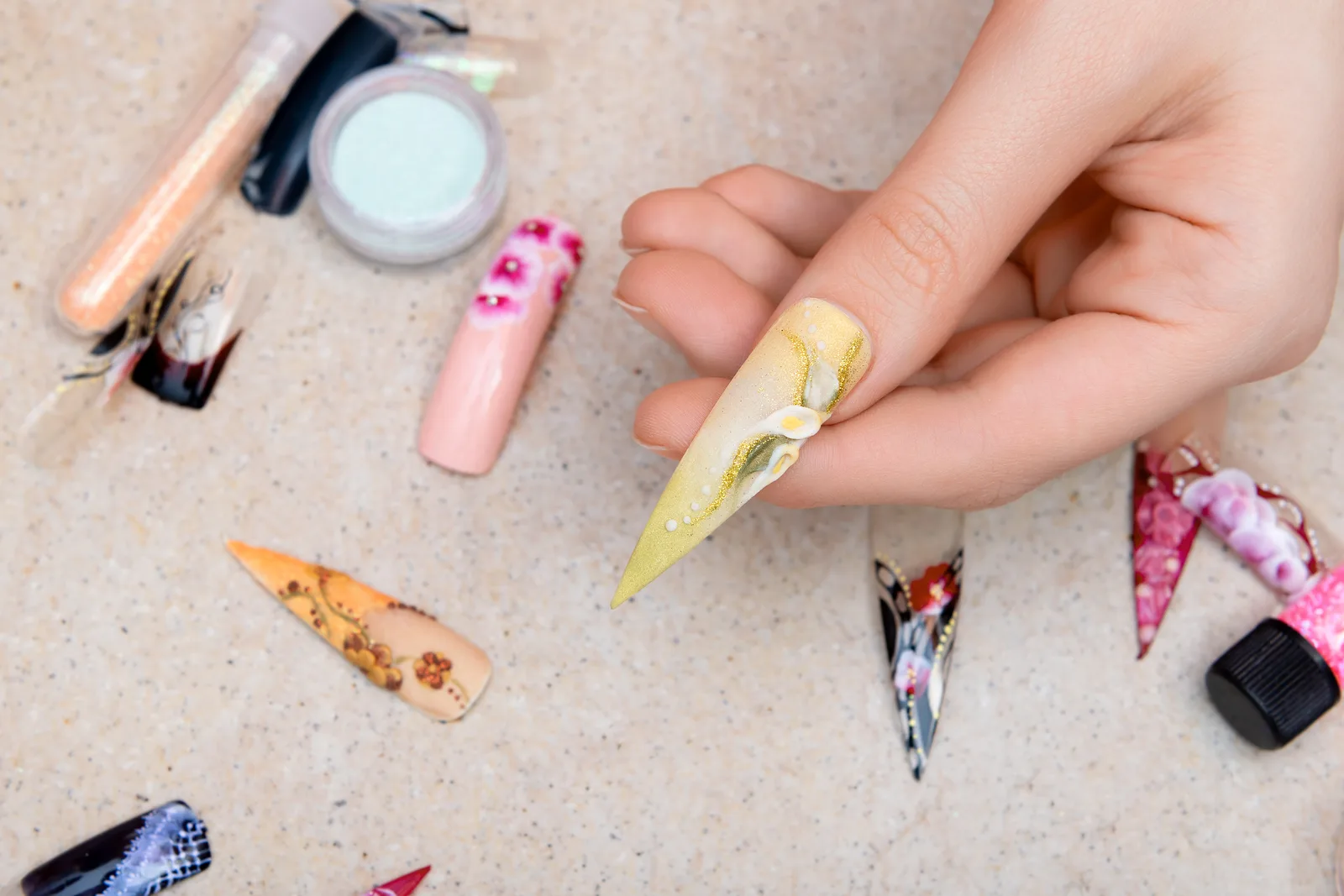
There are two ways to make a nail longer. You can bond a pre-shaped tip to it and overlay, or you can build the length from nothing on a form. Both are extensions. Both use polygel or builder gel. They are different services with different economics, and the question of which to offer has a clearer answer than most people expect: both, and you choose per client.
Here is how they compare on the four things that matter - time, cost, shape and wear - and what to stock for each.
What each one actually is
A soft gel tip is a full-coverage false nail, thin and flexible, that already has a shape, a C-curve and an apex. You size it, bond it to the prepared natural nail, blend the cuticle edge, and overlay it with a thin layer of building product for strength. Most of the shaping was done in a factory.
A sculpted extension is built by hand. A form is fitted under the free edge, polygel is laid out over the natural nail and onto the form, and the shape - length, apex, curve - is made with a brush before curing. The form comes off and you file. Every millimetre of it was your decision.
The comparison
| Soft gel tips | Sculpted on forms | |
|---|---|---|
| Time per set | 60–75 min | 90–120 min |
| Product per set | ~Rs 11 in tips + a thin overlay | More polygel; no tips |
| Shape control | The shapes in the box | Anything you can build |
| Consistency | Ten matching nails, easily | Depends on the hand doing it |
| Extreme length | Limited - a long tip flexes | Strong at any length |
| Skill to learn | Days | Weeks to months |
| Wear | Three weeks, same as sculpted, for normal lengths | Three weeks |
| Best for | Busy days; consistent shapes; clients wanting a natural length | Custom shapes; very long nails; competition work |
Time is the business case
A tip set is a good half hour faster than a sculpted one, and on a Saturday with six bookings that is three extra sets or a technician who finishes on time. The tip has already done the work that sculpting does by hand: the apex is there, the curve is there, the ten nails match because they came from the same mould.
Sculpting earns its extra time when the shape does not exist in a box. A very long stiletto, an unusual almond, a nail built to suit a client's particular finger - these are sculpted or they are not done. And at extreme lengths a sculpted nail is genuinely stronger, because a long tip on its own will flex where a built apex will not.
Fitting a tip so it stays on
Every tip that lifts at the sidewall was the wrong size, and every tip that lifts at the cuticle was not blended. Fitting is the skill.
- Size to the widest point. The tip should sit sidewall to sidewall with no gap and no overhang. Between two sizes, take the larger and file the sides - never the smaller, which leaves a gap that becomes a lift.
- Match the C-curve. Press the tip onto the prepped nail. If it rocks, the curve is wrong for that nail: warm the tip in your fingers to flex it, or sculpt that nail instead.
- Bond without air. Adhesive in the tip's well, press from the cuticle end toward the free edge so air is pushed out, hold. With gel adhesive, cure under the lamp while holding.
- Blend the seam. Buff the step between tip and natural nail until you cannot feel it with a fingertip. This is the step that makes the join invisible, and skipping it is the difference between a tip and an obvious tip.
- Cut and shape. A tip cutter to length, then file the shape. Then the overlay.
Sculpting on a dual form, step by step
The form route, for the nails a box does not cover.
- Prep as for any extension. The full prep system, base coat cured.
- Fit the form. A dual form is a clear mould the shape of the finished nail. Choose the size that matches the natural nail's width at the cuticle; too wide and product flows onto skin.
- Fill the form. A bead of polygel in the form, spread thin at the cuticle end and thicker at the stress point. Less than you think.
- Press and clip. The form goes onto the nail, pressed from the cuticle toward the tip. A fixing clip holds it in place under the lamp so it does not shift while curing.
- Cure and release. Full cure through the form; pop it off. The nail underneath already has its shape and a smooth surface.
- Refine. Clean the cuticle line, file the free edge, thin the sidewalls. Then colour and finish.
The cost of a set, both ways
Worked from today's prices, with the inputs shown so you can substitute your own usage.
| Tip set | Sculpted set | |
|---|---|---|
| Tips | 10 x Rs 1.10 = Rs 11 | - |
| Adhesive | ~Rs 5 (glue) to ~Rs 15 (gel adhesive) | - |
| Polygel | Thin overlay: a 30gm tube at Rs 556 does ~20 sets = ~Rs 28 | Full build: the same tube does ~10 sets = ~Rs 56 |
| Prep, base, top coat | ~Rs 15–20 | ~Rs 15–20 |
| Product per set | ~Rs 60–75 | ~Rs 70–80 |
| Time | 60–75 min | 90–120 min |
The product cost is close. The time is not. That is the whole comparison in two rows: tips do not save money, they save half an hour, and half an hour is what a salon sells.
The learning path
Tips first. The skill in a tip set is fitting and blending, which takes days to get reliable, and the overlay teaches you how polygel behaves without asking you to shape it from nothing. Sculpting second, on a practice stand before a client - the shaping is the same polygel doing more, and by then you know how it moves. Most technicians who sculpt well started on tips; most who only sculpt are slower on a Saturday than they need to be.
What the tips cost, and what to stock
Four kinds of tip in the range, and they are for different clients:
- Medium Almond, 550 pieces, Rs 599. Stock this first. The shape that suits most hands and gets asked for most.
- Medium Coffin, 550 pieces, Rs 599. Second. Squared-off, fashionable, and the other shape clients name. The permanent coffin tips at the same price are the harder-wearing version for clients who keep a set on longer.
- 600-piece Short French Tip, Rs 1,999. Twelve numbered sizes in a case. For the client who wants a clean, short, wearable extension - office nails, not statement nails.
- Traceless Tips, Rs 450. Made to blend at the cuticle without filing the seam. Faster still, and the choice for a technician who finds the blending step is where their time goes.
Plus a tip cutter (Rs 160) to take a tip down to length before it goes on, and something to bond with.
Which shape for which hand
The box says the shape; the hand decides whether it suits. A few rules that save a client from a shape they will regret by day three.
- Almond lengthens the look of a short or wide nail bed, and its tapered tip is the strongest of the fashionable shapes because there is no corner to catch. The safe recommendation for a first set.
- Coffin needs length to read as coffin - on a short nail it looks like a slightly odd square. Its corners are its weak point; a client who is hard on their hands should be told that before choosing it.
- Short French suits anyone who wants their nails to look done rather than long. The 600-piece case exists for exactly this client, and there are more of them than the photos suggest.
- Stiletto and extra-long are sculpted, not tipped. A tip that long flexes; a built apex does not. If the client wants it, it is a form job and it is priced as one.
Show the client the shape on a practice stand in their length before committing. A decision made looking at a real nail is a decision that survives the week.
Glue or gel adhesive
Nail glue at Rs 399 is fast: press, hold, done. It sets in seconds, which is also its problem - there is no repositioning, and a tip set a fraction off centre stays off centre.
The multifunctional adhesive gel at Rs 950 for 30ml cures under the lamp instead. That gives you time to seat the tip, fills the gap at the cuticle edge, bonds across the whole tip evenly rather than where the glue happened to spread, and doubles as a rhinestone and 3D art adhesive. Salons doing tips daily tend to move to it within a month. Someone doing the occasional set is fine with glue.
Sculpting: what you need instead
No tips, no adhesive. Forms - dual forms or paper forms - a fixing clip (Rs 175 for five) to hold a dual form in place while the polygel cures, more polygel per nail than an overlay uses, and a polygel brush you are comfortable shaping with. The practice stand at Rs 280 earns its keep here: sculpting is learned by repetition, and a stand lets you repeat.
Offer both. Choose per client. Tips for the client who wants a medium almond and a colour - which is most of them. Sculpting for the client who brought a photo of something the box does not contain. A salon that only does one of these turns the other client away, and a technician who only knows one is the technician who cannot take the interesting booking.
Where to go from here
The full list of extension products covers everything from prep to top coat with prices. Builder gel versus polygel is the other big fork in the road, and the before-and-after guide shows what a finished set should look like at three weeks, whichever way it was built. The tips and everything to fit them are in nail essentials; the polygel and builder gels in nail extension.