What Products Nail Artists Actually Use for Nail Extensions
17 Sep 2026 · VIRAA Professional · 11 min read

Watch a technician do a full set and the product list looks long. It is not, once you see it in the order it goes on. There are four jobs - prepare the nail, build the length, shape it, seal it - and each job has one or two products that do it. The rest is convenience.
This is that list, in the order it touches the nail, with what each product is for, what it costs on the shop today, and which ones you can leave out while you are starting.
The order matters more than the brand
A set fails at the layer that was rushed. Skip the dehydrator and the base lifts at the cuticle by day four, however good the polygel on top of it. So read this top to bottom rather than jumping to the building product, which is the one everyone asks about and the one that is least often the problem.
- Prep the natural nail. Push back the cuticle, file the free edge, buff the shine off the plate, remove the dust. A block buffer at Rs 42 and a straight file at Rs 40 do this for weeks.
- Dehydrate and prime. A dehydrator like PH Bond (Rs 549) takes the oil and moisture off the plate. A primer like the Viraa Pro Nail Primer (Rs 549) gives the base something to grip. On a client who lifts, Ultra Bond (Rs 549) goes on after the primer.
- Base coat. A thin layer of base coat (Rs 549), cured. This is the layer the extension actually bonds to.
- Tip or form. Either a soft gel tip from a box of 550 (almond or coffin, Rs 599 a box), or a dual form to sculpt against. Tips are faster; forms give a truer custom shape.
- Build. Polygel (Rs 556 for 30gm) laid onto the tip or form with a polygel brush and shaped before it cures. For overlays and short sets, builder gel (Rs 950) instead.
- Cure. Under a lamp, for the time printed on the product. A Legend Plus at Rs 899 is enough for a single table; the equipment range goes up from there.
- Refine. File the shape, thin the apex, clean the cuticle line. By hand, or with a drill bit on an e-file once you are doing sets daily.
- Finish. Colour if the client wants it, then a top coat - Crystal for gloss, Russian Matte for velvet, both Rs 579. Cure, and you are done.
The products, one at a time
Prep: the part that decides whether it lasts
Two products do the work here and they are not interchangeable. A dehydrator removes what is on the nail. A primer changes the surface so the base can bond. Used in that order, a set stays on for three weeks. Used in the wrong order, or with one skipped, it lifts - and the lift shows up as a bad batch of polygel, which it was not.
The prep system collection holds all of it. If a client has lifted on you before, add Ultra Bond to their prep. It is a bonding layer for nails that shed product early - thin natural nails, oily plates, anyone who washes their hands for a living.
What "acid-free primer" means. Older acrylic primers were methacrylic acid, which etched the nail plate. A modern acid-free primer bonds by chemistry rather than by roughening, so it does not thin the nail over repeat services. For gel and polygel work it is the right choice, and it is the only kind in the range.
The building product
This is where the length comes from, and it is the product people spend the longest choosing.
| Product | Price | Best for | Working style |
|---|---|---|---|
| Polygel, 30gm | Rs 556 | Length on tips or forms | Holds its shape; you sculpt it, then cure |
| Builder Gel (solid colours) | Rs 950 | Overlays, short extensions, strength | Self-levels; work fast, cure quickly |
| BIAB | Rs 589 | Natural nail overlays | Brush-in-bottle; thin, easy, not for length |
| Structure Gel | Rs 549 | Reinforcing a natural nail | Self-levelling, used under colour |
If you are building length, buy polygel. If you are strengthening a nail the client already has, buy builder gel or BIAB. The builder gel versus polygel article goes through the trade-off properly; the short version is that most working technicians own both within six months.
Tips
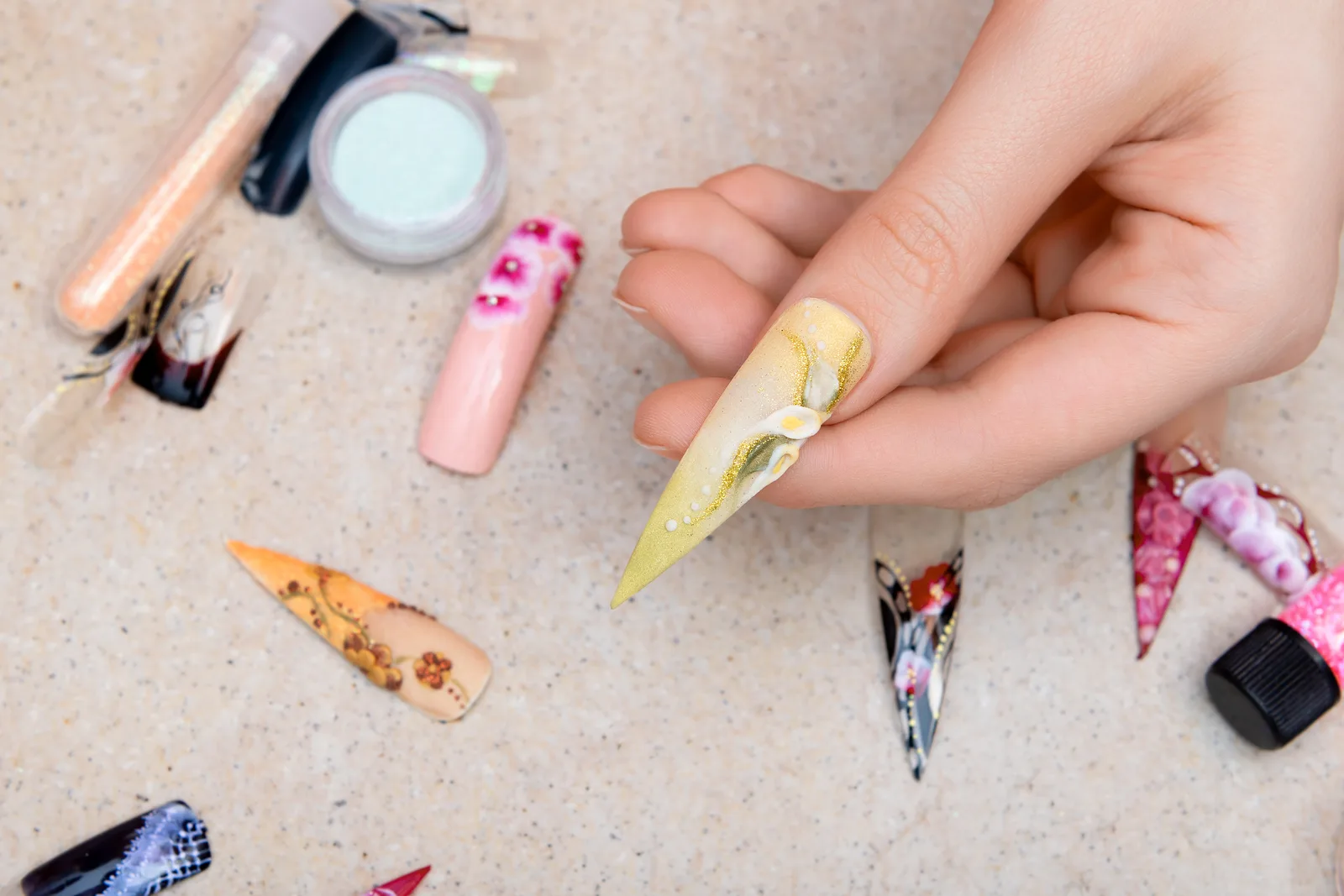
Soft gel tips changed extension work more than any product in the last few years. A full-coverage tip already has the shape and the apex; you bond it, blend the cuticle edge, and the "extension" is mostly done before any building product goes on. A box of 550 at Rs 599 is roughly Rs 1.10 a nail, or about Rs 11 in tips for a full set.
Shapes in the range: medium almond, medium coffin, a 600-piece short French tip at Rs 1,999 for clients who want length without length, and traceless tips at Rs 450 that blend at the cuticle without filing. To bond them, either nail glue (Rs 399) or the multifunctional adhesive gel (Rs 950 for 30ml), which cures under the lamp and doubles as a rhinestone glue.
There is a whole article on tips versus sculpting if you are deciding which to offer.
Finish
Top coat is the layer the client actually sees, and the one that gets judged in a week's time. The top coat range now has four distinct finishes at Rs 579 - there is a guide to choosing between them. For an extension set, Crystal is the default: clear, hard, glass-like.
The lamp
Every gel product on this page cures under UV/LED light, and the lamp is the one piece of equipment the whole desk depends on. Two things matter: that it cures your products fully in the time on the label, and that a hand fits flat inside it so the thumb is not shadowed. Advertised wattage is a marketing number - a 380W lamp is not four times better than a 90W one - and LED count tells you more about coverage than power does.
| Lamp | Price | Suits |
|---|---|---|
| Viraa Pro Legend Plus | Rs 899 | A single table; a technician starting out |
| L8B, 72 LEDs | Rs 1,901 | Full-hand coverage for daily extension work |
| SUN X6 Max | Rs 2,199 | A busy desk; fast cures on builder products |
| S10 rechargeable | Rs 3,499 | Home visits and bridal work without a socket |
Under-curing is the most common cause of a top coat that dulls or a builder that stays soft in the middle, and it is almost never the lamp's fault - it is the hand tilted, the thumb done separately and forgotten, or the timer pressed before the hand was in. Cure every layer for the full time, flat, and the cheapest lamp on this list will outperform the most expensive one used carelessly.
Files, buffers and grits
The number on a file is its grit, and the lower the number the coarser it is. Product - polygel, builder gel, acrylic - takes a 100 or 150 grit for shaping and a 180 for refining. The natural nail never sees anything coarser than 180, and the shine comes off it with a 240 or a buffer block. Using a 100 grit on a natural nail is the fastest way to thin it.
- Straight file, Rs 40 - shaping the free edge of product.
- Half moon file, Rs 60 - the curved edge sits into the cuticle line for refining.
- Block buffer, Rs 42 - taking the shine off the natural nail at prep, and smoothing product before top coat.
- Curved buffer, Rs 80 - follows the C-curve on a finished extension.
Files are consumables. A file that has done ten sets is a file that is polishing, not cutting, and the sign is that you are pressing harder. Keep a box, replace them without thinking about it, and never share one between clients.
Removal
Nobody budgets for removal and every set needs one eventually. Polygel and builder gel are filed off - by hand with a 100 grit, or with an e-file and a carbide drill bit - down to a thin layer over the natural nail, which is then buffed or soaked. Gel polish soaks off in acetone in ten to fifteen minutes. Removal is where a client's natural nail gets damaged if it gets damaged at all: file the product, not the nail, and stop when you can see the natural plate through what is left.
Filing product makes dust, and dust is the thing NIOSH is most concerned about in nail work. A dust collector at Rs 5,029 - or the 4-in-1 with drill and lamp built in at Rs 13,300 - pulls it away at the source. It is not a first-week purchase. It is a first-quarter one.
What a full set costs in product
Work it from your own numbers rather than trusting anyone's headline figure. The arithmetic is simple and the inputs are on this page.
The tube is the variable. Count how many sets you get from one - it depends on length, apex height and how much you file off - and the per-set cost of polygel is the tube price divided by that number. A technician getting fifteen sets from a tube is spending around Rs 37 on polygel per set; someone building long stiletto extensions might get eight, and spend twice that. Both are fine. What is not fine is not knowing which you are.
What you can skip at the start
- A dust collector. Not for the first month. But not for long after that either - NIOSH puts extraction at the source ahead of a mask, and filing polygel makes a lot of fine dust. The dust collector article covers when to add one.
- An e-file. Hand filing works. It is slow, and removal is slower, but the nail is the same. Add one when you are doing sets daily.
- A brush set. One good polygel brush is enough to build. Art brushes are for art.
- A practice stand. Useful for learning; the set of five is Rs 280. Skip it if you already have hands to practise on.
Three shopping lists
The same desk at three points in a career. Prices are today's shop prices, and the totals are what the list would actually cost.
| Starting out | Working daily | Full desk |
|---|---|---|
| All In One kit (tips, polygel, base, primer, colour, brush, buffer) - Rs 2,761 | Polygel Extension Kit - Rs 3,208 | Polygel x2 and Builder Gel - Rs 2,062 |
| PH Bond - Rs 549 | PH Bond, Primer, Base - Rs 1,647 | Full prep system incl. Ultra Bond - Rs 2,196 |
| Crystal Top Coat - Rs 579 | Crystal and Russian Matte - Rs 1,158 | All four finishes plus No Wipe - Rs 2,895 |
| Legend Plus lamp - Rs 899 | L8B lamp - Rs 1,901 | SUN X24 Max - Rs 3,699 |
| A couple of files - about Rs 100 | Files, buffers, wipes - about Rs 400 | 3-in-1 dust collector - Rs 5,029 |
| - | Polygel brush, tip cutter - Rs 384 | 2-in-1 rechargeable lamp and drill - Rs 3,145 |
| about Rs 4,900 | about Rs 8,700 | about Rs 19,000 |
The starter column is a complete, working extension desk for under Rs 5,000. The middle column is what the same technician buys over the next three months, as bookings tell them which finishes and which lamp they need. The third column is a salon table, and nobody should buy it on day one - the dust collector and the e-file are the two items that pay for themselves fastest once the volume is there, and the two that are wasted before it is.
The complete list
If you want all of it in one order, the Polygel Nail Extension Kit at Rs 3,208 bundles two tubes of polygel, 550 tips, glue and two One Coat shades, and the All In One kit at Rs 2,761 covers seven products for someone starting from nothing. Both are priced under buying the parts separately; both are sitting in the offers collection. The polygel kit article goes through what is in the box and what it can and cannot do.
Or buy the pieces. Prep, one building product, a box of tips, a lamp, a top coat. That is a working extension desk, and everything above is what gets added to it.