How to Open a Nail Salon in India: Costs, Licences and a 90-Day Plan
21 Jul 2026 · VIRAA Professional · 5 min read
Opening a nail salon is mostly a sequencing problem. People sign a lease before they know their numbers, or buy equipment before they know their service menu, and end up paying rent while they figure the rest out. This is the order that avoids that.
If you have not yet decided whether the business is worth entering, start with the state of the nail salon business in India.
1. What it costs
Published ranges for the Indian market cluster into three bands. These are setup costs — the money spent before you take a rupee.
| Format | Setup cost | What that buys |
|---|---|---|
| Home studio | From ₹30,000 | One chair, a lamp, a starter product kit. No rent. |
| Small independent studio | ₹5–10 lakh | 2–3 stations, basic fit-out, 3 months of stock |
| Mid-size studio | ₹12–25 lakh | 4–6 stations, designed interior, trained team |
| Franchise | ₹20–40 lakh | ₹5–10 lakh fee plus ₹10–20 lakh fit-out, brand and system included |
Where the money goes in an independent studio
| Line item | Typical range | Notes |
|---|---|---|
| Interior fit-out | ₹3–8 lakh | Varies most by city tier — this is the line that shrinks in tier 3 |
| Equipment | ₹5–10 lakh (premium) | Can be far lower to start; see the equipment guide |
| Sterilisation unit | From ₹1.5 lakh | Not the place to economise |
| Opening stock | ₹1–3 lakh | Colour range drives this |
| Team training | ₹2–5 lakh | Certified technicians command around 20% higher wages |
| Salary buffer | ~₹3 lakh | 4 technicians, 2–3 months, before revenue covers payroll |
| Compliance consultant | ₹20,000–30,000 | One-time, optional, usually worth it |
Most owners report breaking even in 6 to 9 months, assuming the location was chosen well and the salary buffer was real. The buffer is what people cut first and regret most.
2. The licences you actually need
There is no single "nail salon licence" in India. What you need is a stack of ordinary business registrations:
- Shop and Establishment registration — state-level, covers your premises, hours and staff. Apply once you have an address.
- Municipal trade licence — from your local corporation. Requirements and fees vary by city.
- GST registration — see the threshold below.
- Fire safety clearance — depends on the size and floor of your premises.
- Health / sanitation permit — required by some municipalities, not all. Check locally.
- Professional tax registration — applicable in several states once you employ staff.
Get the GST threshold right. A salon supplies services, and the GST registration threshold for services is ₹20 lakh of aggregate annual turnover — ₹10 lakh in special-category states. The widely repeated ₹40 lakh figure applies to suppliers of goods, not services. If you also sell retail product over the counter, take advice on how your turnover is treated. Aggregate turnover is calculated all-India, not per outlet.
3. Choosing the site
Three questions, in this order:
- Can your target client get here easily and park? Nail appointments are 45–90 minutes and often booked around other errands. Convenience beats prestige.
- What is the rent as a share of realistic monthly revenue? Model it before you sign — the earnings breakdown by city tier gives you a starting frame.
- Is there natural footfall from adjacent businesses? Gyms, salons, cafés and clinics all send clients your way. An isolated unit means you pay for every customer through marketing.
4. Set your menu before you buy anything
Your service list determines your equipment list, not the other way round. A studio doing gel polish and basic art needs a fraction of the kit that an extensions studio needs.
Typical Indian pricing to anchor against: basic gel polish and simple nail art run ₹500–800; acrylic or gel extensions generally start around ₹800 and run to ₹1,500. In Mumbai, extensions span roughly ₹1,500–5,000; in Delhi, roughly ₹1,200–4,500, depending on the salon.
Bundling works: a manicure, pedicure and nail art sold together at ₹1,500 beats three ₹600 services sold separately, both for the client and for your chair utilisation.
5. Buy the kit
Once the menu is fixed, the shopping list follows from it. We have written that out in full in the nail salon equipment and product list, including what to buy on day one versus what can wait until month three.
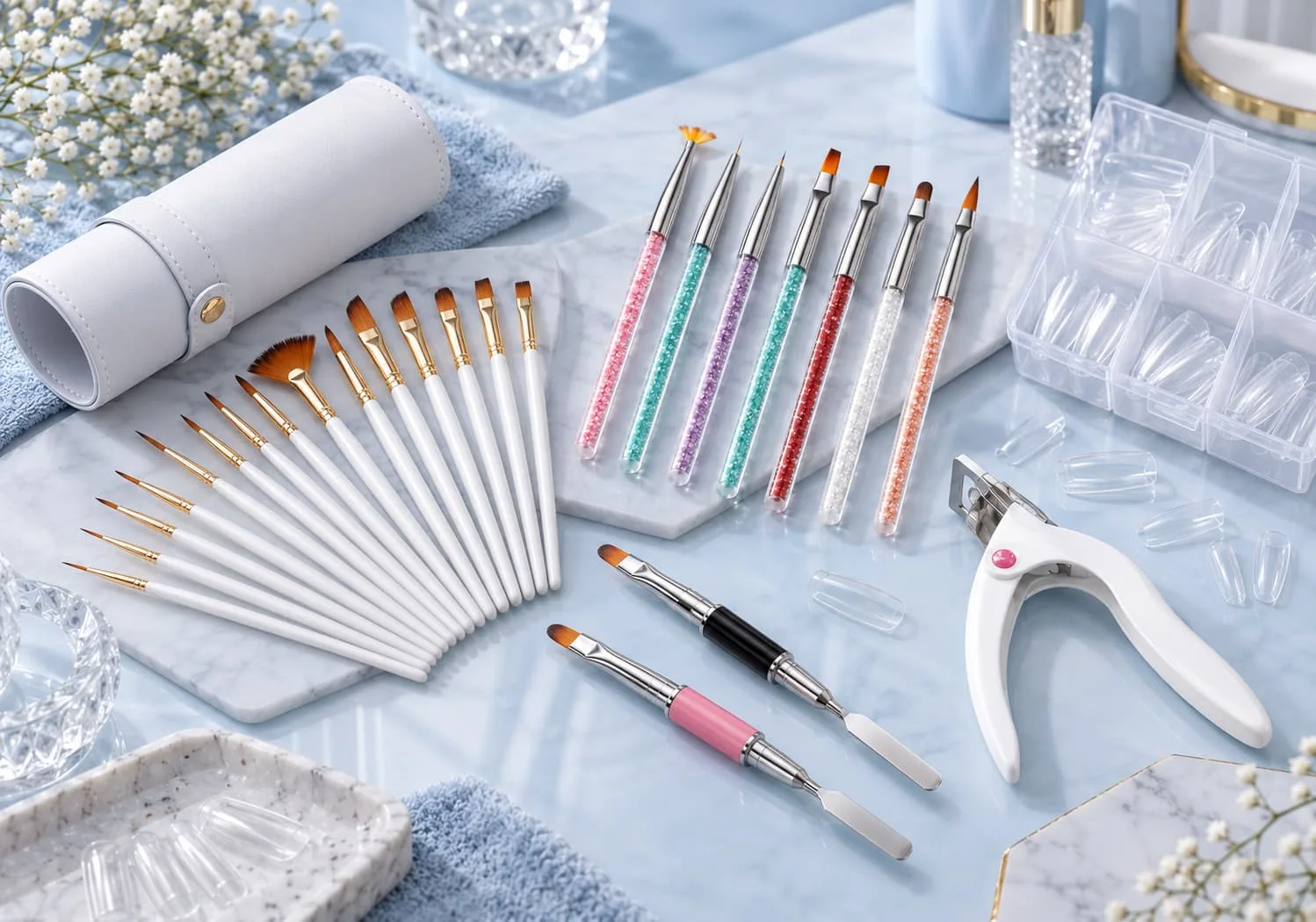
The short version: a curer, a drill, a prep system and a colour range you can actually reorder. Our nail equipment and prep system ranges cover the first two.
A 90-day launch plan
| Days | Focus | Done when |
|---|---|---|
| 1–15 | Model the business. Rent, rates, capacity, break-even. | You can state your monthly break-even revenue as one number. |
| 16–30 | Site search and negotiation. Registrations started. | Lease signed, Shop & Establishment applied for. |
| 31–55 | Fit-out. Equipment ordered. Hiring and training. | Stations installed, team booked into training. |
| 56–75 | Stock in. Menu and price list finalised. Booking system live. | You could serve a client tomorrow. |
| 76–85 | Soft launch. Friends, family, discounted slots. | Every technician has done 10+ real appointments. |
| 86–90 | Public opening. Local Google and Instagram live. | Google Business Profile verified with photos and hours. |
Marketing spend at launch is best weighted heavily towards referrals and local search rather than broad advertising — a common split is roughly 70% referral incentives and word of mouth, 20% local Google and Instagram, 10% experiments.
The mistakes that cost the most
- No salary buffer. Revenue does not arrive on day one, and payroll does.
- Buying colour before deciding the menu. Stock is the easiest money to tie up and the hardest to release.
- Skimping on sterilisation. One infection incident ends a local reputation permanently.
- Assuming the ₹40 lakh GST threshold applies. It does not, for services.
- Underestimating your own chemical exposure. You are in the fumes all day. See the note on TPO and HEMA in the market overview.
Sources
- Dingg — How to Open a Nail Salon in India
- ClearTax — GST Registration Threshold Limits
- Minou Nails — Cost of Nail Extensions in India
- IBEF — Styling India's Growth: The Indian Salon Landscape
Figures were current when this article was published on 21 July 2026. Market data and salary bands date quickly — check the linked sources before relying on a number for a business plan.